Haute Lumière · The reading
Every retreat is either a party or a reckoning, and the rare ones are both
A senior facilitator writes at 2:47 in the morning about the week that has just happened, and about the nine years of preparation standing behind it.
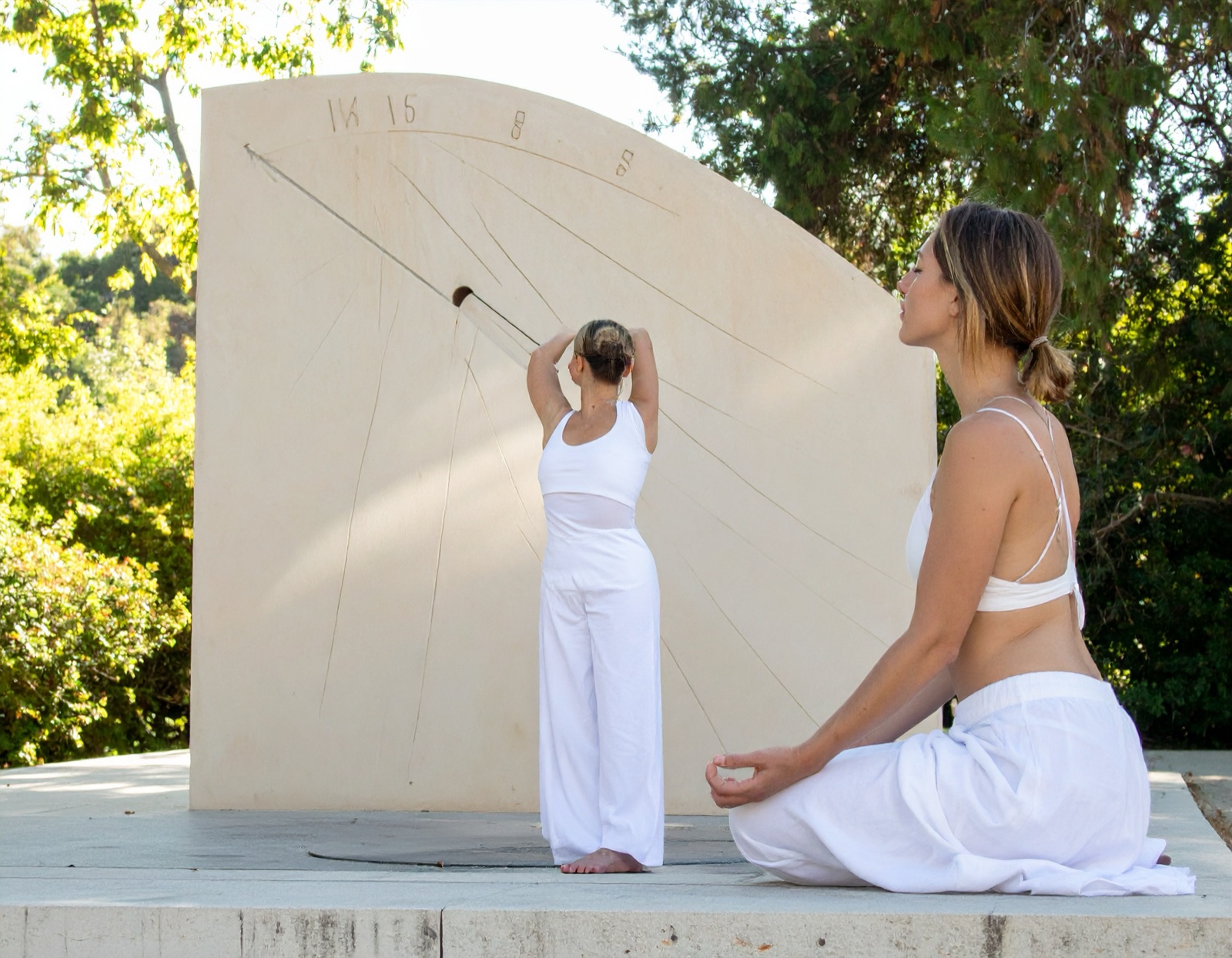
She came two days early, which is the part of the week that never appears on an invoice.
THE TWO ROOMS
There are two kinds of week for sale, and most people with the means to buy either have been to both. The first has a villa, a chef, a pool the colour of a good gin, and a schedule loose enough that nobody has to do anything they would rather not. It is a lovely week, and it has entirely worn off by the second Tuesday home. The second has a circle of chairs, a box of tissues placed with some ceremony, and a facilitator who says the word held more often than is strictly required. That one lasts longer, and nobody in the room laughs once.
This book is a letter written at 2:47 in the morning from the kitchen of a fourteenth-century villa in the hills above Lucca. Its author is a senior facilitator sitting three rooms away from twenty-two people who are slow-dancing barefoot to a cellist who started at half past nine and shows no sign of stopping. She is writing because she has promised herself she will never let one of these weeks evaporate without a record. What she sets down, almost in passing, is the most useful argument anyone has made about this work: the party and the depth are not two products, and they are not in tension. Each is the other's precondition.
It is a party. It is a transcendental experience. It is a wedding without a wedding. It is a wake without a wake.
Most operators pick one and quietly let the other go, because the two appear to demand opposite conditions. A party runs on permission — the schedule bends, the fire is lit, the decision waits until somebody feels like making it. Depth runs on containment — the round starts when it said it would, the phone goes in the basket, and the person who wants to leave is invited to stay a little longer than is comfortable. Held loosely, the container leaks. Held tightly, the joy never arrives. Whichever the operator is better at is the retreat they sell, and they call the missing half a matter of house style.
The letter's claim is that this is a false choice, and that the resolution is structural rather than tonal. A cohort that has laughed until it fell over on Wednesday will go somewhere on Thursday it would never have gone cold. A cohort that wept together on Thursday dances on Friday like people with nothing left to protect. Neither half is decoration. Remove one and the other thins into what the field usually delivers: a beautiful week nobody changed at, or a heavy week nobody enjoyed.
What follows is the machinery. Almost none of it is mysterious and almost all of it is unglamorous — arrival times, a notebook, a wooden table, a referee's whistle, and the question of who has been assigned to sit with the person who is about to come apart. The week works because somebody decided each of those small things on purpose, years before this particular cohort booked.
THE LAND FIRST
The facilitators fly in two days early. So do the chefs. The musicians arrive on the Monday, the guests on the Tuesday afternoon, and the reason for the gap is a sentence the author has heard Ammanuel Santa Anna say at least forty times: the field has to be in the bones of the room before the guests' bodies enter it. He does not deliver it as a slogan. He says it the way a conductor says let us tune before we rehearse, with a small inward attention, as though checking his own pitch first.
On that first afternoon he walks the perimeter of the property barefoot with a small notebook, and the notes are not logistical. Where does the wind come through. Where does the morning sun land. Where is the quiet corner that the person who needs to cry alone on Day Three will find on Day Three. He has done this for nine years on six continents. The letter calls it the single most important hour of any retreat, and says that almost no other operator in the field does it at all.
The quiet corner has to exist before anyone needs it. Nobody in distress discovers a place that was not already there.
The economics of that hour are worth stating plainly, because it is the first thing an operator cuts. Two days of early payroll for the senior bench and the kitchen, a villa held empty of paying guests, and an afternoon spent walking around barefoot doing something that looks, on a spreadsheet, like nothing at all. Against that: a week in which nobody has to improvise the place where grief goes. The saving is legible and the cost is not, which is precisely why the practice is rare.
Underneath it is a principle that travels well beyond retreats. A room teaches people how to behave in it before anybody speaks. Chairs at a slight angle rather than in a rank, a door that closes properly, a corner with a view and no traffic through it — these are instructions, and people obey them without noticing they have been given any. Design them and they work for you all week. Leave them and they work anyway, on whatever they happen to be saying.
So the first move of this craft is not a session plan and not a run of show. It is arriving early enough that the building has stopped being a venue and started being a host.
THE NOTE INSIDE
There is no check-in desk, because there is no desk. Guests are met at the gate and their bags are carried, and in the courtyard there is a long wooden table holding one hand-bound journal for each of them, their name on the cover in the administrative lead's calligraphy. She also runs the flight bookings, because at this company everyone has at least two jobs and at least one of them is artistic. Tucked inside each journal is a handwritten note from whichever facilitator had the longest call with that guest before arrival.
The notes are specific, and the specificity is the entire mechanism. Not welcome, not we are so glad you are here, but the thing the person actually said on the phone weeks ago — that they were tired of being the one who held it together for everyone, and that this week they do not have to. The whole set takes the team about two hours on the night before arrivals. Guests open them alone in their rooms before dinner, and roughly half of them cry.
A generic welcome is a form letter on better paper, and it is received as exactly what it is.
The reason it lands so hard is not sentiment. It is that the note arrives before the guest has performed anything. Every other place these people are seen — the board, the fund, the family, the cap table — sees them after the performance and largely because of it. A note naming the thing underneath, delivered before they have unpacked, breaks that sequence in the first twenty minutes. Some of them have not been met that way in years, and the letter says some of them have never been met that way at all.
It also does a piece of structural work, quietly. By dinner on the first night every guest knows that somebody in this building has been paying close attention to them for six weeks. That knowledge is what makes Thursday possible, because nobody opens the worst of themselves to a staff they suspect of improvising. Two hours of handwriting on Monday night buys a level of disclosure on Thursday afternoon that no facilitation technique can produce on the day.
Which is the shape of the whole week in miniature. The moments that feel expensive are downstream of a small, dull, early act that somebody did not skip.

The name on the cover was written by hand the night before. That is the whole of the technique, and it does not scale.
FIVE LINEAGES
The founder came up through five traditions and refused to abandon any of them. Four years apprenticed to a somatic teacher in Oakland, who had herself apprenticed with one of the early founders of the embodied movement field. Two years with a dance psychology lineage in Brazil that traces back to the orixás and to a body-based school that emerged in São Paulo in the 1970s. A decade sitting with a Zen teacher in Northern California, who taught him the difference between contemplative seriousness and contemplative rigidity. Three years of formal music composition, and the rest of his life of informal.
Then the one almost everybody misses: seven years as a hotel concierge, in three cities, before he ever called himself a facilitator. The letter is unambiguous about what those years bought. The airport pickups feel the way they feel because of the concierge years. The flowers in the rooms come with notes naming something specific because of the concierge years. So does the moment, in every retreat, when a guest says with wet eyes that they have never been hosted like this in their life.
Hospitality cannot be faked. It can only be inherited from the people who taught it, practised for ten thousand hours, and then offered to strangers as though they were family.
Internally these are the five lineages — somatics, dance psychology, contemplative practice, music, hospitality — and at the end of their second year every senior facilitator is asked to name which two or three are theirs in the deepest sense. The author's are dance psychology and hospitality. The cellist's are music and contemplative practice; he sat with the same Zen teacher, which is how the two men met. The chef's are hospitality and somatics, and she will argue, if asked, that cooking is somatic work and that every meal is a nervous-system practice for whoever eats it.
In the opening circle on Day Zero the teachers are named out loud. Most of them are not in the room. Some of them are no longer alive. The room goes still when it happens, and the guests do not always understand why, and they do not need to, because the stillness lands regardless. It is the only part of the week that exists entirely for the staff, and it is done in front of everyone.
The argument being made here is about dilution. A field that presents its methods as though they came from nowhere has cut itself off from the only quality control it ever had — a teacher who can say that is not what I showed you. Naming the lineage is not modesty and it is not credentialism. It is how a practice stays specific enough to be handed to somebody else intact.
THE HELD EDGE
In her fourth year, in Costa Rica, a guest went somewhere on Day Three that nobody else on the team could quite hold. A technology executive in his mid-forties who had buried his brother three years earlier and had not, in his own words, let himself feel any of it, because there was a Series C to close. The Series C closed. The grief did not. He began to crack open in the afternoon round and the room went very quiet.
She felt something in her chest go yes, and she leaned forward. Not physically — with attention: the steady felt sense of I am here, you are not alone, you do not have to perform this, it can be exactly what it is. He cried for forty minutes. She said nothing for the first thirty. When she finally spoke it was one sentence, that his brother would be proud of how hard he had been carrying this, and he cried harder, and then he laughed, and then he told the room a story about his brother involving a Halloween costume and a stolen golf cart.
Thirty minutes of saying nothing is not the absence of technique. It is the technique, and almost nobody can do it.
That night the founder took her aside on the balcony and told her that holding the edge was her gift. He did not elaborate and did not need to. From that retreat on, whenever a guest approaches something real — grief, terror, ancient shame, the class of thing most facilitators flinch away from because it frightens them — she is the one asked to hold it. Sometimes the ask is a glance across the room. Sometimes it is a message on the team thread mid-session: she is about to go in, can you take her.
The operationally interesting part is not the gift. It is that the gift has a name, an owner and a dispatch protocol. Most teams hope that whoever happens to be running the round will turn out to be the right person for whatever happens inside it. This one decides in advance who takes the edge, and the others have agreed, without ego, that it is not them. That is the whole difference between five capable soloists and something that can actually play together.
It also protects the guest from the most common failure in any such room, which is a facilitator managing their own discomfort in public. The flinch is small and a cohort reads it instantly. Once a room has watched somebody in authority hurry a person through their grief, nobody in that room goes near an edge again for the rest of the week.
THE LIVING QUESTION
At the welcome dinner the circle opens with a single instruction: introduce yourself not by name and title but by the question you are currently living. A chief executive said hers was whether she could ever stop performing. A seventy-one-year-old hospice doctor said his was what is left to give. A thirty-four-year-old researcher said his was whether he was in the right life. The room held all of it, and by the end of the round nobody knew anybody else's job, and everybody knew the shape of everybody else's interior.
Status is an anaesthetic. A room that trades in it will be comfortable, and nothing will happen there.
Dropping the title is not a pleasantry and it is not a novelty. In a cohort of founders and executives, rank is the currency the room would otherwise spend five days exchanging, and the exchange is pleasant enough to fill the whole week without anyone noticing what failed to occur. Take the currency out of circulation on the first night and the cohort has to find something else to trade. The only other thing on hand is the truth.
The instruction also works as a filter in both directions. A person who cannot name the question they are living learns something about themselves in the act of trying, gently and in company. A person who names it precisely has already done half the week's work, and the team now knows where to stand on Thursday afternoon. One round, forty minutes, and the staff holds a map of twenty-two interiors that no intake form was ever going to produce.
There is a companion rule, taught in the first forty-eight hours, and it belongs beside this one because it is the other half of the same mechanism. No is a complete sentence and will be honoured without explanation. The researcher arrived saying he was open to whatever he was told to do, which sounds like willingness and is nearer to absence, and the team spent two days teaching him he was permitted to decline. He learned, and the letter notes that he learned beautifully.
A cohort that cannot say no cannot meaningfully say yes. Consent is not a compliance layer bolted to the front of the week for the lawyers. It is the thing that makes the middle of the week worth anything at all.

Most of them text from baggage claim. The week is not decided at the car; it is decided somewhere around the second Tuesday.
STRUCTURED SILLINESS
Wednesday afternoon is Lila Day — divine play — and its centrepiece is a barefoot soccer match refereed by the founder, badly, on purpose. He wears an absurdly ornate whistle on a velvet ribbon that he found in a flea market in Lisbon four years ago. He calls fouls that did not happen. He issues yellow cards for laughing too loud. He once awarded a penalty because he did not like somebody's expression.
The incompetence is the design. A properly refereed game invites competence, and competence is the one costume these people cannot get out of, because they are all extremely good at things and have been for decades. A game whose rules are visibly arbitrary removes the possibility of playing it well, and once winning is off the table the only thing left to do is play. The cohort laughs itself into something close to an altered state, and that state is the actual deliverable of the afternoon.
Make the rules unserious and the people can stop being. Nobody relaxes inside a game they could still lose.
One guest, a hedge fund founder described to the team beforehand as difficult, scored late in the match by sliding through the grass on his knees in white linen trousers. He stood up with grass stains down both legs and his hair full of leaves and shouted into the Tuscan afternoon that he had not done that in thirty years, and the cohort cheered him for what felt like a full minute. At dinner that night he told the author he had been depressed for eleven years and had not realised it until that goal.
That sentence is the argument for the entire day. He did not arrive at it in a round, or through an assessment, or in conversation with a facilitator. He arrived at it because his own body produced a reaction that eleven years of his life had not asked it for. Play is diagnostic in a way introspection is not, precisely because you cannot brief yourself in advance on what you are about to feel.
And there is a sequencing claim underneath it, which is the part most operators miss when they copy the format. The silliness is not a break from the work and it does not go wherever there happens to be a gap in the schedule. It runs the day before the hardest day, because a cohort that has been ridiculous together on Wednesday has already stopped performing by the time Thursday asks it to.
THE EDGE DAY
Thursday is the Edge Day: a Living Assessment in the morning, an appreciative inquiry round in the afternoon, and a team that has known since Tuesday's circle roughly who will go where. The chief executive who arrived in a cashmere travel set and a composure you could hear creaking was barefoot in a linen shift by lunch. In the round she told the cohort about a daughter she had not spoken to in two years.
The hospice doctor sitting beside her took her hand without saying a word, and they stayed like that for the rest of the round — two strangers fifty years apart in age, holding hands in a room full of crying people in an Italian olive grove. The author says she will remember that image until she dies, and it is worth noticing what produced it. Not an intervention. A man who had been given three days of permission, a room in which taking a stranger's hand was not strange, and nobody in authority narrating what was happening.
The best moments in the room are the ones the staff had the discipline not to interrupt.
The dinner that night is the strangest meal of the week and it is meant to be. The cohort is wrung out, nobody is performing any longer, and the conversation is unlike any they have had in years. There is a wild-mushroom risotto and a fennel salad the author cannot describe without making sounds. The cellist plays very quietly in the corner. People eat slowly and laugh easily.
The hedge fund founder told a story about his grandfather that he said he had never told anyone, crying and laughing at the same time, and the researcher reached across the table and put a hand on his shoulder, and he did not flinch. The author repeats that phrase — did not flinch — because of what the same man had been like on Tuesday, guarded in a way you could practically have photographed. Two days had passed.
The candlelit dinner is not a reward for a hard day. It is the landing, and it is the reason an Edge Day can be run at all. A cohort opened in the afternoon and sent to its rooms at six would spend the night alone with everything it had just said. Opened in the afternoon and fed slowly by candlelight until midnight, it metabolises instead. The meal is doing clinical work in the costume of a very good dinner, which is close to this house's definition of hospitality.
THE MUSIC
The cellist flew in from Rotterdam on the Monday and by Friday night has not slept meaningfully since Tuesday. Some time in the small hours he tells the author, eyes shining, that he has never played better in his life, and that he is not playing them — they are playing him. She believed him at the time. She still believes him at 2:47 in the morning, which is when she writes it down.
Music sits in the five lineages for a structural reason, and the letter states it directly: it is the only medium the team knows that can hold joy and grief in the same chord. A room can be laughing and grieving inside the same forty-minute round, and what it needs at that moment is something that does not have to choose between the two and does not have to explain itself afterwards. Language cannot do that. A speaker in the ceiling cannot either.
A recording cannot notice that the room has changed. That is the whole of the difference, and it is not a small one.
On the Friday there was a bonfire and a band of local musicians the founder has worked with for six years, and the kind of dancing that reminds people they have bodies, and karaoke, in which the researcher sang Take On Me in a falsetto that brought the house down. Then around midnight the band took a break and the cellist began playing alone, and the energy of the room turned into something older and gentler. The dancing slowed. People paired up, mostly not romantically, just humanly, and held each other and swayed.
The hospice doctor, who had told the author on the first night that he had not danced since 1987, danced for three hours and had to sit down on a stone wall to catch his breath from laughing. He caught her watching him and said he had forgotten this was inside him. She wrote the sentence into her journal that night, and says it is, in some real way, the entire reason she does this work.
The same instrument does the opposite job on Friday morning, underneath the Living Score composition: mostly improvisation, with a Bach suite when the room needs gravity. One musician, two functions, no announcement on either occasion. That is what it means to call the music a thread rather than an act — it is stitching the party and the depth into one fabric, and the moment anyone in the room notices it as programming, it has stopped working.
THE FRIDAY FACE
On the Friday morning each guest spends two hours composing a Living Score: the practices, rituals and commitments they will carry home. Paper, pens, watercolours, hand-bound journals, cello in the background. The chief executive's began with the line that she would call her daughter on Sunday. The author read it over her shoulder when she was allowed to, and had not yet asked, at the time of writing, whether the call was made. She will ask at the thirty-day check-in, and she has a feeling.
The numbers the house keeps are set down in the letter without ceremony. All of them will be different on Monday. About 80% will be different in a year. About 60% in five years. About 40% will attribute some specific decision in the rest of their lives — a marriage saved, a company pivoted, a child finally seen, a calling finally followed — to that week. The author is careful to say that these are not metaphors, that they are measured, and that they are real.
The measurement that matters is the one you would go on keeping if no client ever asked to see it.
Beside the numbers sits the measure the staff actually trusts. On the last morning the cohort comes down the stone stairs in mismatched borrowed sweaters, hair in their faces, wearing a soft, opened-up expression the team calls, internally, the Friday face. The letter says it is more of a receipt for the week than any printed Living Score or post-retreat metric. It cannot be audited, and everyone in the building can see it.
The refusal that keeps all of it standing is in the last paragraph, and it is a commercial decision as much as a philosophical one. Twenty-two guests a week, six to ten weeks a year. A senior bench paid, the author says, about twice what anyone else in the field pays. A team that runs a retreat for itself every year and sits in it as guests, because a team that stops going through the work will eventually betray it without noticing. And a standing refusal to dilute the work in service of scale.
Each of those choices is expensive and each is the same choice. The product is attention; attention has no economies of scale; and an operator who forgets that will sell a larger number of thinner weeks and be unable to say afterwards what went missing. The letter's closing image is of a man nine years earlier, walking the perimeter of his first retreat property barefoot with a small notebook, checking the wind and the morning sun, and trusting what he found there.
The Notion Living System Orchestra is one chapter of 25,867 words, written across a single night in a kitchen above Lucca while the cello was still going. It stands on the shelf at The Luminous Library, and the reading is free — the whole letter, not an extract of it. Buying the volume is for keeping the file.
Free to read
Free to read, and free to hear. Every chapter of every book in this house, and every narration of it, is open to anybody. No account, no card, nothing to cancel.
The Notion Living System Orchestra — 1 chapter, 25,867 words.
Buying a volume is now for keeping it — the EPUB, the PDF and the press file, yours on disk. The reading is free either way.
Read it free Keep the files — $44.44What is in it
A room that can only hold laughter will never be trusted with grief.
Preparation is the part of the work nobody sees and everybody feels.
Attention has no economies of scale. Everything else about this business does.
Name your teachers, or the practice thins by one generation every time it is taught.
Keep looking
Every phrase on this page opens into the house search. The shelf holds The Luminous Library and six other shelves, and the reading is free.